


AI · · 7 min read
One photo in, a 3D model out: what the open image-to-3D models give you
TRELLIS and Hunyuan3D 2.1 both turn a single picture into a textured mesh. The differences that matter are the material output, the VRAM bill and the licence.
You can turn one product photo into a textured 3D file today, for free, on your own machine. The two open systems worth knowing are Microsoft's TRELLIS and Tencent's Hunyuan3D 2.1. TRELLIS gives you more output formats and an MIT licence. Hunyuan3D gives you physically based materials, which is the thing that decides whether your mockup survives contact with real lighting, and a licence that is not valid in the European Union, the United Kingdom or South Korea.
That last sentence is the whole decision for a lot of studios, and it is easy to miss. If you are reading this in the Americas, the restrictive-looking option is open to you. If your client's legal entity sits in Dublin or London, it is not.
Everything below is from the two repositories, read on 22 September 2026. No models were run for this article; these are documented capabilities and the makers' own example renders.
What actually comes out
TRELLIS "takes in text or image prompts and generates high-quality 3D assets in various formats, such as Radiance Fields, 3D Gaussians, and meshes". In practice its example script writes a .glb with a textured mesh and a .ply of Gaussians, and the GLB texture size is a parameter you set, 1024 in the published example. GLB is the format your renderer, your web viewer and most 3D apps will take without argument.
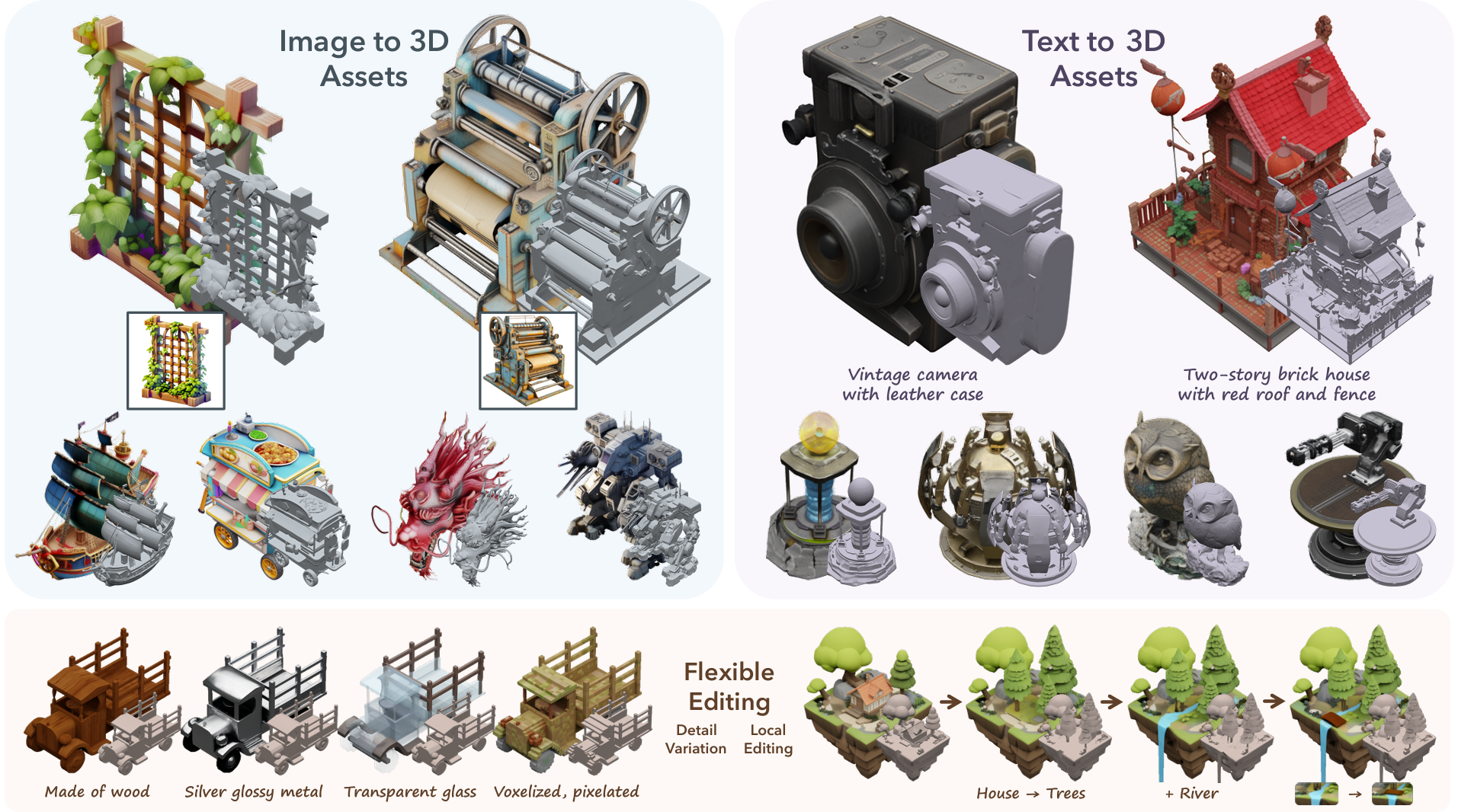
Hunyuan3D 2.1 splits the job in two: a 3.3B image-to-shape model and a 2B texture model. The texture half is the part Tencent leads with, describing a pipeline that replaces "the prior RGB-based texture model" and "leverages physics-grounded material simulation to generate textures with photorealistic light interaction (e.g., metallic reflections, subsurface scattering)".
Why PBR is the line between a prop and a mockup
A baked RGB texture is a photograph wrapped around a shape. The highlights are painted on. Move your light, and nothing moves with it; the object sits in your scene looking like a sticker.
A physically based material splits the surface into separate channels for colour, metalness and roughness, so the renderer works out the highlights itself. That is what lets a generated bottle cap actually read as aluminium when you swing a softbox around it, and it is why the difference matters more for packaging, product and set dressing work than any polygon count.
So the short version of the choice: TRELLIS when you want geometry and flexibility, Hunyuan3D when the surface has to behave under your lighting.
The part of the TRELLIS teaser worth stealing
Look at the bottom strip of that first image. The same truck appears four times, described as made of wood, silver glossy metal, transparent glass, and voxelised. Beside it, a small island is edited in stages: a house becomes trees, then a river is added.
That is the workflow, not a demo. Generate the object once, then ask for the material variants, which is precisely the packshot-in-four-finishes job that otherwise eats a day. The repository describes this as local 3D editing and asset variant generation, and lists it among the things it offers that earlier models did not.
The hardware bill, which is the real barrier
| TRELLIS | Hunyuan3D 2.1 | |
|---|---|---|
| Smallest documented GPU | NVIDIA, at least 16GB | 10GB for shape, 21GB for texture, 29GB for both |
| Documented test environment | NVIDIA A100 and A6000 | Python 3.10 and PyTorch 2.5.1 with CUDA 12.4 |
| Operating system | "Currently tested only on Linux" | The README states macOS, Windows and Linux |
| Model sizes | 1.2B image-to-3D, up to 2.0B for text | 3.3B shape, 2B texture |
| Licence | MIT for the models and most of the code | Tencent Hunyuan 3D 2.1 Community License |
Hunyuan3D's Gradio app takes a --low_vram_mode flag, which is the only concession either project documents for smaller cards. Neither of these is a laptop job on integrated graphics. If you do not have the GPU, the practical route is a hosted demo, and then you are back under someone else's terms of service rather than the licence below.
The licence clause that decides who may use it
TRELLIS is simple: "TRELLIS models and the majority of the code are licensed under the MIT License", with a note that a few submodules carry their own terms.
Hunyuan3D 2.1 is not simple, and the detail is worth reading rather than skimming. Its licence opens by stating, in capitals, that the agreement "DOES NOT APPLY IN THE EUROPEAN UNION, UNITED KINGDOM AND SOUTH KOREA", and defines its Territory as "the worldwide territory, excluding the territory of the European Union, United Kingdom and South Korea". Then:
- You may not use, reproduce, modify, distribute or display the works, or their output, outside that Territory
- If, on the model's release date, your products had more than 1 million monthly active users in the preceding calendar month, you must request a separate licence from Tencent
- You must not use the output to improve any other AI model
- Distributions need a notice file with Tencent's copyright line
Read the second bullet again if you work for a large brand. And note that the restriction follows the output, not just the model, which is unusual and directly relevant to a deliverable you are handing to a client. The same family of clauses shows up in Tencent's image models, unpacked in what the open image model licences actually say.
Getting a better result out of either one
- Start from an image, even for a text idea. TRELLIS's own note is blunt: always generate an image first with a text-to-image model, then feed that to the image-to-3D model, because its text-conditioned models "are less creative and detailed due to data limitations". Your existing prompt craft is not wasted here, it is the first stage.
- Give it one object, clearly lit, from a readable angle. Both systems are reconstructing a whole object from partial evidence. Everything the camera cannot see is invented.
- Do not expect multi-image conditioning to fix a bad single image. TRELLIS implements it, and says so honestly: it is a "tuning-free algorithm without training a specialized model, so it may not give the best results for all input images".
- Budget for cleanup in your normal 3D app. Which leads to the part neither repository promises.
What neither repository claims
Read both READMEs for what is absent, not just what is present. Neither documents quad topology, a sensible UV layout, real-world scale, or anything about rigging. Hunyuan3D's own benchmark tables, where it beats TRELLIS and others, score things like condition following and texture similarity metrics. They are maker-run evaluations of maker-chosen measures, and none of them is "a modeller opened this file and was happy".
That is not a criticism of the work, which is genuinely impressive. It is a scoping note. These systems produce a convincing object for a render, a background prop, a quick client visual or a starting mesh. They are not producing a rigged, retopologised asset for a game engine, and nobody involved claims they are.
FAQ
Which one should I try first?
TRELLIS, if you just want to see whether this is useful to you: the licence is MIT, the output formats are flexible, and GLB drops straight into most pipelines. Move to Hunyuan3D when a material needs to respond to your lighting and you have checked the Territory clause.
Can I sell a render made from one of these?
For TRELLIS, MIT is about as permissive as licences get. For Hunyuan3D, only inside the Territory, and only if you are under the monthly active user threshold. Neither is legal advice, and both licences are short enough to read in full before a client project.
Do I need a reference photo from every angle?
No, single-image input is the main path for both. More views can help TRELLIS, with the caveat above. What matters more is that the object is unobstructed and evenly lit, because occluded geometry gets invented.
Where does this leave hosted tools?
Hosted services are faster to try and set their own commercial terms, which may be simpler than a model licence. The reason to care about the open versions is that the output stays on your machine, which is often the deciding factor for unreleased product work.
Sources
- Microsoft, TRELLIS repository, read 22 September 2026, source of the output formats, hardware requirements, text-to-3D note and MIT licence statement
- Tencent Hunyuan, Hunyuan3D-2.1 repository, read 22 September 2026, source of the PBR description, model sizes, VRAM figures and benchmark tables
- Tencent Hunyuan 3D 2.1 Community License Agreement, source of the Territory definition and the monthly active user clause
More to read
Design · · 8 min read
The variable font axes past weight and width, and what they are for
Google Fonts keeps a public registry of every axis it will honour, from Grade to Wonky to Year. Here are the real ranges, and the rule that breaks unlisted axes.
AI · · 8 min read
Z-Image runs on a 16GB card. Turbo is the variant to be careful with
Tongyi-MAI's 6B open model ships in four variants. Its own table rates Turbo's quality Very High and its diversity Low, and that trade decides which you want.